
Serendip is an independent site partnering with faculty at multiple colleges and universities around the world. Happy exploring!

"Yarning" A Playful, Precarious, Potential Right Relationship
Our concluding activity is a diffraction of Eve Ensler's litany, Karen Barad's concept of entanglement, and John Humbach's discussion of right relationship.
Each member of the class wrote their individual contribution to the litany enumerated (anonymously) below. The model we offered was, "I am over ______./, (and) I commit to ______." All of the slips of paper were mixed together before being passed out at random. One by one, we entangled our ideas by tossing the ball of yarn to the member of the class whose utterance was shared. They then read the slip in their own hands and repeated the tossing process, being careful to pull enough excess string from the ball of yarn prior to toss! Below is a cropped image of our circle and the yarn, captured by Anne Dalke.

Please, classmates, return here for inspiration and conversation. If I did not procure your contribution, feel free to email me (jmussa@haverford.edu) and I'll gladly add it to this post. The semester is coming to a close now, but we're just getting started, eh? ;)
---------------------
I'm over observing from the sidelines as a passive ally for rape and sexual assault survivors. I commit to the active pursuit of JUSTICE.

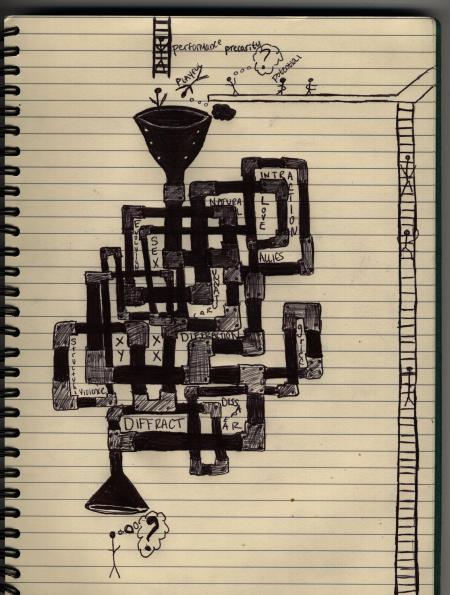
The Entanglement Machine!
During class tonight I drew this, thinking about some of the main themes of our course.

info session: solidarity delegation to Nicaragua
I have received funding from CPGC to lead an educational delegation of six Bi-Co student to Nicaragua from May 30-Jun 8. This 10-day study tour, which will introduce students to the political, economic and cultural histories of Nicaragua, is coordinated by ProNica, a Quaker organization founded in 1987 to build “sustainable cross-cultural relationships between the people of North America and Nicaragua” and will be guided by Carmen Gonzalez, who has lived in Nicaragua for over 20 years.
Our delegation begins in Managua, where we stay at Quaker House, learn more about Nicaraguan culture, speak with community leaders, and visit sites important in the Sandinista revolution. From there, we travel to smaller cities and villages in the central highlands, such as San Marcos, Matagalpa, San Ramon, Esteli, Largatillo, and
Achuapa to meet with grassroots organizations that provide integrated health care, opportunities for childhood and adult education, and link producers to fair trade markets. We will speak with women whose husbands and children were killed during the Sandinista Revolution and the Contra War, with adults who provide a safe space for children living in La Chureca, the largest open land-fill in Central America, with women’s healthcare providers, with farmers, librarians, artists and shopkeepers. These interactions will help us understand on a deeper level how international policies and interventions affect the lives of our Nicaraguan neighbors and how we can be in solidarity with them as they build healthier and more sustainable communities.

Apples To Apples: The Gender and Sexuality Studies Way!
For our final performance, aybala50, lgleysteen, S.Yeager and I created our own version of the (as I've come to find at college) popular game Apples to Apples. Using words that were particularly important in our discussions throughout the semester, we created adjective and noun cards and asked for volunteers in the class to play.
And we we didn't just make this game to make people have fun! (Though this was part of our intention.) We thought that just that simple game revealed many of things that we have been discussing this semester. First of all, we thought of the ways in which each player diffracted the adjective through their own personal lens. But this was not the only thing at play. Though the player was thinking of how they could use their words to 'match' with the adjective, they were also considering which word would win them the round and be 'judged' as being the best card. This demonstrated the entanglement between the players and the judge.
Additionally, there was further entanglement when considering that we had them play in front of the whole class. This was another factor in the decision that the player made as they were also aware that they were appearing and thus, had to choose a word that the class would understand. There was also entanglement to us, as the creators of the game, as we gave them them a fairly limited choice of words.
Lastly, we wanted to demonstrate how each of the words did not lend themselves to a fixed definition. Thus, we managed to question our use of labels and the way in which we define certain terms.


Evolution Revolution: An "Androgynous" Teach-In
essietee: Here’s a little know fact about me: I’m secretly in love with fashion and beauty. I love that a person can put on one outfit one day to reflect their mood or a certain personal ideal, then completely change that image whenever they please. I struggled with this fluidity of fashion as a teen living in an environment where you had to declare yourself as one thing or another (ie: jock, cheerleader, theatre nerd, etc.). It’s been a long road, but I’m finally comfortable wearing a dress and heels to go out on a Friday night, then switching into cargo shorts and an old t-shirt for Saturday evening. This proved to be a point that I thought about while taking and posing for these pictures: we started out with photographs of our individual faces and body parts, then moved on to clothing and makeup. I felt like a paper doll, grabbing different options from my closet; some of my clothes were things that I haven’t worn since my first year of college, while others are staples that I usually wear at least once a week. Though changing multiple times in a common space where anyone could view me (sorry, housekeeping!), I was very comfortable in my presence with my group-mates and with the clothing choices I made. They reflect who I am: a multifaceted incidivual who believes in expression of self and personal creativity. It’s like the lyrics for the song featured in our video, “Androgynous” by Joan Jett and the Blackhearts – “She's happy with the way she looks / She's happy with her gender.”

Remote Ready Biology Learning Activities

Remote Ready Biology Learning Activities has 50 remote-ready activities, which work for either your classroom or remote teaching.
What's New? Subscribe to Serendip Studio
A Random Walk
New Topics
-
1 week 21 hours ago
-
1 week 21 hours ago
-
1 week 21 hours ago
-
1 week 21 hours ago
-
1 week 3 days ago
