
Ham and Salmon: A Receipt for the Role of Science in Society
This exhibit will explore ways in which the Ham House and Garden collaboration with the Storybox Collective gives insight into the history of science.
What is the Storybox Collective?
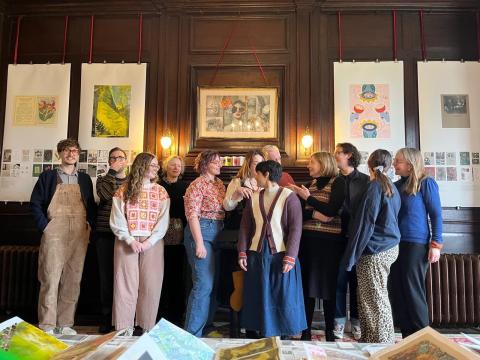
The Storybox Collective is an international artists group that creates site specific installations. In 2017, Designer and Senior Lecturer at Kingston School of Art, Clare Conway founded the Storybox Collective. The Collective utilizes collaboration with cultural sites across the United Kingdom as a basis for deep research and interdisciplinary exhibits. It is a group of artists, designers and writers working with historic collections and archives to explore the potential of creative research through collaborative making. Previous collaborations of the Storybox Collective include exhibits with The William Morris Society, Glyndebourne Opera House in Sussex, and Wilton’s Music Hall.
What is the Ham House?
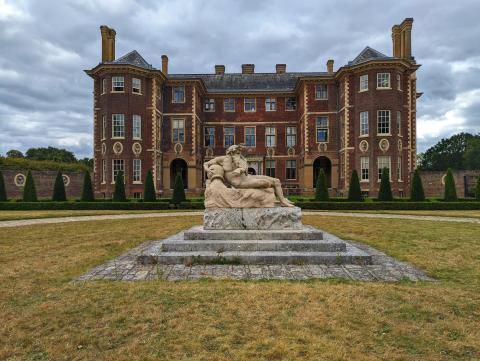
The Ham House and Garden is a National Trust property on the bank of the River Thames in Richmond. The National Trust writes: it is the creation of the tenacious Duchess of Lauderdale and her husband, the Duke, who together transformed Ham into one of the grandest Stuart houses in England. Ham House boasts a significant collection of artwork from cabinets with marquetry, lacquer and inlay to portraits of its inhabitants. There is more to the property than the house; there is the kitchen garden, the still house, the plats, the cherry garden, and the wilderness.
What is the art of housekeeping?
The first exhibition by the Storybox Collective featured members research and initial works in the form of sketchbooks and postcards. Ham House, New Perspectives: Past, Present and Place ran from 15 February - 5 March 2025. The focus was on process also known as the way research is turned into artwork by means of an iterative and collaborative process akin to the way a laboratory research group works. It is important to note that the artist’s notebook performs the same function as the scientist’s notebook as a record of exploration. The notebooks also call back to the handwritten and historical production of knowledge.
What is the science of housekeeping?
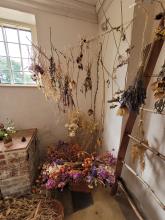
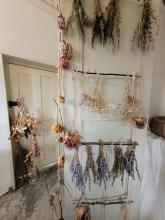
The still house was built for Elizabeth, Duchess of Lauderdale in order to perform extended housekeeping duties. It is the only surviving seventeenth century still house that was built for use by the Duchess who lived at Ham in the 1680s. Still-rooms had become common in country houses by the 17th century; they were fitted with stills to distill the cordial waters for banquets, medicines or scents. Here is where the Duchess utilized her knowledge of chemistry in order to keep her household in health and luxury. This is the source of the chemicals needed to run the estate. Perfumes, pickles, jams of my!
What is distillation?
The name still house comes from the chemical process of simple distillation. I can recall my first success in organic chemistry laboratory was mastering the assembly of a micro distillation apparatus in a fume hood. Bryn Mawr College Laboratory LEcturer Maryellen Nerz-Stormes writes: distillation most commonly refers to the process of vaporizing a liquid in one vessel and then re-condensing it in another vessel. We students had to use steam distillation to isolate clove oil from whole cloves. Let me quote from her to explain the enduring power of distillation:
You might wonder why you would not just take the cloves and press the oil out of them or extract the cloves directly with an organic solvent such as methylene chloride or ether. The problem with pressing the oil out (and this can be done) is that the yield is very low. You might be able to imagine that much of the material would get caught up in the solid matrix that constitutes most of the mass of the cloves. The problem with a direct organic extraction is that many other nonvolatile organic components of the clove would also dissolve in the solvent resulting in a much more complex mixture. Purification would become time consuming and material would lost with each added step. With steam distillation, only the volatile components are collected and they can be isolated exhaustively if enough water is used. In summary, steam distillation is an ideal way to separate volatile compounds from nonvolatile contaminants in high yield. For these reasons it has been used extensively in the isolation of natural products.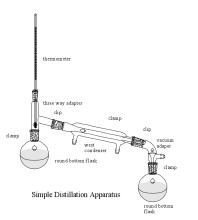
What is the Still House?
The second Storybox Collective exhibit at Ham House sought to the contextualize scientific practice of distillation. The Still House: Plants, Potions, and Power overflowed the room itself. Here the botanical laboratory is highlighted as a site of women’s knowledge and the progress of cosmetics, medicine, and science. The collective writes: the exhibit explores interwoven themes including the power of plants, the enduring role of women and nature in supporting health and wellbeing, endangered crafts and digital technologies, and the tension between self-sufficiency and privilege. The Storybox Collective utilized a variety of techniques from the historical to the contemporary to produce artwork that reflects the complex mixture of roles that still houses served in 17th century England.
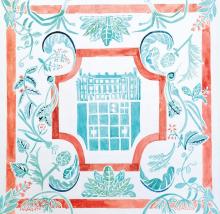
Julia Buckley’s piece is a Rug — From Turf to Table velvet and cotton 128 x 128cm. She explains, that much like the demarcation of female space signified by the use of a chequerboard floor in the Still House and Duchess’s bathroom my textile blurs the boundaries between garden and interior. It could at once serve as wall hanging, floor rug, or even tablecloth (rugs adorn the table in many paintings of the period).
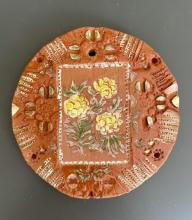
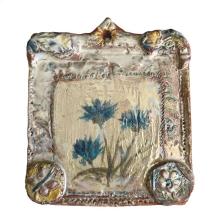
Clare Conway’s piece is Forget-Me-Not: A Cabinet of Floral Miniatures, Terracotta with colored slip and luster glazes. The project focuses on five once-common wildflowers—Lady’s-slipper, Pasqueflower, Deptford Pink, Cornflower, and Globeflower—now rare, endangered or under threat due to issues such as grazing levels, the conversion of pasture to arable land, and the loss of over 97% of wildflower meadows since the 1930s. Displayed in a cabinet lined with bespoke wallpaper and accompanied by a handmade book, the work echoes the language of miniature portraiture while quietly mourning the threats to our native flora.
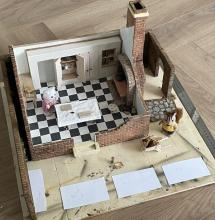
Honey Postle’s piece is The Curious Adventure of the Sylvanian Still House 1:16 Hand-crafted model. The miniature model of a 17th-century Still House and its gardens encourages young historians to imagine the daily rituals,remedies, and quiet industry of this female-led space. Whose hands that prepared, preserved, and healed. Through model-making, I explored how play can be a powerful tool for learning, especially for younger audiences. The project invites reflection on our historical relationship with the earth and how natural materials have supported human wellbeing for centuries.
Annie Yonkers piece is a A Storybox Almanac, Risograph printed and handbound booklet. She begins with the inquiry: where does power lie when it comes to sharing knowledge? Is it in our own hand, or is it in the mass (re)production of words on a page? Inspired by the tension in the written word in the 17th century, A Storybook Almanac explores themes around recipes and spells, medicine and magic, printed and handwritten knowledge.
What is lost without the history of science?
The Storybox Collective utilized art, history, and science to engage with Ham House and Garden through a pair of interdisciplinary exhibitions. The collective writes: drawing on Ham House’s unique collections, its intriguing history, and vibrant gardens, the exhibition blurs the boundaries between garden and interior, connecting past and present, fact and folklore — inviting visitors to examine the role of historic places and collections as sources of creativity. Their reflection on the process of creating the exhibits illustrates the interdisciplinary nature of inspiration for artists. The way in which the Storybox Collective approached Ham House and Garden aligns with Paul Grobstein’s suggestion that science need not be isolated from society. He has written about the possibility for self-reflection as a methodology within science and that people trained in self-reflection might contribute to science knowing itself in this way. Grobstein writes:
My objective in developing a story of science as story is not to attack science but rather to encourage the same kind of critical examination of our understandings of science that science itself promotes in its examination of other phenomena. A critical perspective associated with the practice of science as story telling is, I will argue, the source of science’s demonstrable power. That perspective, turned on science itself, is needed for the continuing productive evolution of the distinctive and valued role science plays in human culture.In this story of science as a story, it is the history of science among many others that links to culture and welcomes artists like the Storybox Collective.
Works Cited:
Maryellen Nerz-Stormes, 'Lab Manual Fall Organic Chemistry Laboratory Bryn Mawr College,' Maryellen Nerz-Stormes, 1 September 2017 http://www.drnerz.com/Labs/Distillation_Lab_August_25_2015.pdf [Accessed 10 May 2026].
The National Trust, 'Ham House and Garden,' Events, The National Trust, 1 January 2026. https://www.nationaltrust.org.uk/visit/london/ham-house-and-garden/events/90257b4b-ee57-4e5a-973f-4adbda1f53ee. [Accessed 10 May 2026].
The National Trust, 'Ham House and Garden,' Visit, The National Trust, 1 January 2026, https://www.nationaltrust.org.uk/visit/london/ham-house-and-garden [Accessed 10 May 2026].
Paul Grobstein, 'Revisiting Science in Culture: Science as Story Telling and Story Revising, Journal of Research Practice, Volume 1, Issue 1, Article M1, 2005 https://jrp.icaap.org/index.php/jrp/article/download/9/18-inline=1.html. [Accessed 10 May 2026].
The Storybox Collective, 'Ham House 001,' The Storybox Collective, 1 January 2025, https://thestoryboxcollective.org.uk/ham-house-1 [Accessed 10 May 2026].
The Storybox Collective, 'The Still House: A collaborative research and project development space to share resources and ideas and record the project's progress,' Padlet, 1 August 2024. http://padlet.com/KU51972/the-still-house. [Accessed 10 May 2026].