
Serendip is an independent site partnering with faculty at multiple colleges and universities around the world. Happy exploring!

Web Event 1-Silence and performance
No one has ever really understood why I have a tendency to be so quiet in class. I still don’t think that I know the logic behind it. Nonetheless, I’ve sat through countless parent/teacher conferences where my high school teachers said, “Your daughter is just so bright but she never speaks up in class” and “she’s such a shy students.” I watched as my parent’s eyes widened in complete confusion. There was no way these teachers could have been talking about their daughter; their 5”4’ ball of energy, who never seems to stop talking. This is the part of me that has never made sense. Why is it that the second I step into a classroom, my thoughts freeze and my voice immediately vanishes, leaving me empty in my chair as I listen to everyone else’s lively discussion. But take that chair out of the classroom and put it on a theater stage. Give me a script or lyrics to sing. Standing on a stage, prepared to act, sing or dance, is more freeing for me than any liberal arts college classroom has been so far. These dichotomous aspects of my personality are at war with each other, searching for a compromise between the girl whose heart bleeds on stage and fearfully shrinks in the classroom. I want to learn represent myself knowing that there is a shy student and an exuberant performer inside of me and hopefully find a compromise between classroom expectations and my own.

Grandmothers' Struggles with Google
This is a new username. It's still someone who's in the class, but it's not attached to a lot of very identifiable information (as opposed to my old one). Anne and I agreed that writing about my (maybe) queerness would be a more interesting topic than the one I initially proposed, but it's a little more clandestine than a literary analysis of The Dollhouse. I'm just starting to come out at Bryn Mawr, and people back home don't know I'm queer yet--I really don't want my grandmother to find out about this because someone in the family thinks it would be fun to teach her how to use Google, so broadcasting my name no longer seemed like such a good idea.

Web Event #1: Sister, Sister
When I was growing up, my sister and I could not have looked anymore alike visually. We had the same eyes, lips, hair type, skin tone, shoe size and much more. At the core, we were identical twins. Stylistically however, we were polar opposites. As a way to individualize ourselves from one another, we developed different tastes in clothing, toys, books, and expression. Justine was the tomboy, I was the girly girl. I loved pink, Justine hated it. Even with all of these differentiations however, we could never get rid of the fact that we were identical twins. We could make it a little less obvious, but that label would never completely go away. Not that we wanted it to, we enjoyed the benefits that came with being twins and enjoyed our similarities as well as our differences. However, the inability for us to be together without a label that neither one of had chosen nor could get rid of made for some hard times when it came to establishing ourselves as separate people. My sister and I’s failure to create identities completely independent of each other makes me question whether our identities as human beings are relational?

Web Event #1: Fear and Self-Representation
“I guess I think that maybe perhaps if you want to hear to my opinion, but I’m no expert, so I’ll make it brief…” is not an uncommon way for me to preface what I have to say. I am a strong believer that a five-minute-long disclaimer is enough to protect me from any criticism whatsoever. I believe strongly in a lot of other things, too (for one, I consider myself a feminist), but you wouldn’t know it from the way I talk. I sit there biting my fingernails, taking in what others have to say, feeling that their thoughts are much more intelligent and valid than my own. I dread being called on and sharing what I have to say, the best case being that I just said something painfully obvious and the worst case being that I said something completely wrong. I fear judgment. I fear criticism. I fear being wrong. Luckily, I’m not alone in my fears. My fear of speaking out is shared not only by other women, but many people who are marginalized by society. Fear limits self-representation to a self-preserving performance, making us unable to represent ourselves as we wish to be represented.


My anti-self-portrait essay
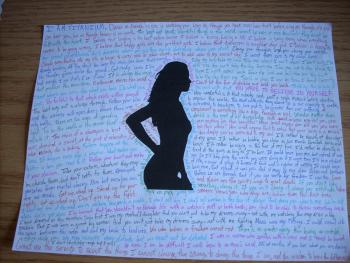 Relational Definitions of Ourselves
When our professor proposed the idea of making an anti-self portrait, I questioned the idea because I doubted my drawing ability and I struggle with looking at myself. I am scared of what I will find there. However, when Laura Swanson mentioned it could be any medium, I realized that I am not the kind of person who can be represented by a picture, but by words. The words I chose are all inspirational quotes and lyrics either about keeping going even when it is hard, standing up for what you believe is right, or just enjoying life. The outline of the woman is a representation of me, surrounded by all of the inspiration, facing whatever challenges are coming my way and enjoying life. It is purposefully an incomplete picture of me because I defy many categories that people attempt to put me into.

web event #1: using Tumblr as a medium of self-representation
I didn’t expect anyone to take notice of my self-portait when Laura Swanson came to visit. A screenshot of a Tumblr customization page, it felt simple, despite the meaning I had given it, but when I spoke with others, they understood what I had meant. Tumblr, like many social media, stands at a peculiar intersection between personal thought and private identity, allowing users to specifically tailor their blogs to express the particular representation they choose at the time. Among women, it has a particular following; as stated by Niels van Doorn’s team: “The traditionally ‘feminine’ act of diary writing…is adopted by both men and women, challenging the traditional understanding of technology and the Internet as masculine territories.” Thus, it allows for a specific niche where users of any gender can express themselves in the manner that they choose. Through Tumblr, when one has the opportunity to match an identity to a real life face, it can express hidden facets of a personality one is unable to share in daily physical contact, allowing a kind of freedom for users using it to get away from their typical life.


Bryn Mawr College: A look at the representation of race (web event 1)
A fact about owls: their eyes are fixed in their sockets, which means they must turn their entire head to see in a different direction. Like the owl, we often only see what is presented in front of us, but sometimes we must turn our heads in order to gain a fuller perspective of the people and world around us.
Part of the Bryn Mawr College mission “seeks to sustain a community diverse in nature and democratic in practice” believing that “considering many perspectives we gain a deeper understanding of each other and the world.” It is through engaging with others who are different from us that we can broaden our perspectives and reshape our choices. One way in which the College tries to represent their diversity is through their website; a medium readily accessible to millions around the world. However, the representation of diversity displayed on the Bryn Mawr website, through photos, statistics and language is incongruous to the actual representation on campus. This discrepancy is misleading to prospective students and the false idea about what the college presents itself as cherishing is detrimental to the wellbeing of all members of the college community.
A Little History First


Remote Ready Biology Learning Activities

Remote Ready Biology Learning Activities has 50 remote-ready activities, which work for either your classroom or remote teaching.
What's New? Subscribe to Serendip Studio
A Random Walk
New Topics
-
4 days 15 hours ago
-
4 days 15 hours ago
-
4 days 15 hours ago
-
4 days 15 hours ago
-
1 week 14 hours ago
