
Serendip is an independent site partnering with faculty at multiple colleges and universities around the world. Happy exploring!

Education levels the playing field?
In reflecting on the various readings that we have done up to this point, it seems to me that the answer to this question is both yes and no. In the case of Luttrell’s and Shorris’s students, education certainly did “level their playing fields” in a sense, for Luttrell and Shorris gave their students the educations that they had never before had. With these educations, the students were then able to move towards higher education and attend colleges and technical schools. This is education in its idealized form - for education is, at its best, meant to level the playing field as it did for these students.
But in another sense, we must keep in mind that not everyone has access to the type of education that Shorris and Luttrell gave their students. I think about the movie “Waiting for Superman” and the children in that movie who attended school and worked hard, but did not have a level playing field simply because they did not have access to the “right” schools and the “right” teachers. With this thought in mind, education is a means of leveling the playing field, only to the extent that one has access to “good” education - education in which students and teachers engage in an active classroom and where students are encouraged to learn.

Locating Home
We talked last class about the power of calling our own bodies “home.” Clare’s book repeatedly addresses the body as home, as a habitat as important for exploration as Clare’s northwestern home forests and the factors that have influenced his growth as an individual. I have to wonder, though, if all the talk of creating a home in a body underscores a long-held and often destructive dichotomy of mind/body in western culture. This dichotomy distinguishes the body as something foreign, something to be understood and mastered by the mind (which also encompasses soul/spirit/personality/etc.).
Does calling our bodies “home” unnecessarily separate the mind (which is doing the calling/naming) from the body? I think that separating my power for naming from my body is a comforting notion. By calling my body home, I can contain the essence of my self, as a thing capable of naming and designating, into something separate and “above” the body. This naming creates an implicit hierarchy of value—as long as I still have the faculty of reason, of naming, the state of my physical body is relatively immaterial. But what if someone, for whatever reason, cannot “name” her body as home? Can she still exist as a “full” person? What does that even mean?

Leveling the Playing Field?
Can education create a level playing field? For Kai Davis, education simply reminded her of the lower playing field that she was expected to live, work, and die at. Her white classmates were surprised to see that she could excel in the AP classes that they believed to be above her level, creating a dichotomy of "us" versus "them" wherein she was out of the place that had been prescribed for her by her pigmentation. She also seemed disappointed with the reaction of her African American peers, feeling like "having a 4.0 made [her] 4 shades lighter," setting her apart from the "normal" black students who struggled to stay in school and keep their grades up. Being smart was a "white" trait, one that Kai was seemingly betraying her race to have.
It's interesting to think about whether affirmative action is a force to level the playing field, or whether it further separates African American students from their white peers. Are we really encouraging diversity? Or does it create isolation within top universities for diverse students, while leaving other members of their race behind who have not met the bar to come and be isolated?
While I am firmly pro-affirmative action, it's troubling to think about the way diverse students are regarded when outside of their "normal" playing fields.
Kai Davis and Education
I have heard the words of Kai Davis way too many times. Kai’s poem neither startled me nor surprised me. I’ve have felt these heavy emotions before and have even felt this type of pain. Although I am not black, I feel as though the experiences that Kai Davis talks about do not only occur within the black race-- it occurs in all races.
What really stuck out to me was when Kai Davis asks, does a 4.0 gpa mean that she’s four shades lighter? She goes on to say that intelligence is a white trait and that “acting smart” means “acting white.” This is something I have been told before. Especially because I went to a private school. My friends from my public school often thought that I left them to go to a private school because I was “too good for them” and that I would probably fit in better with the white people anyways. But how can the color of my skin affect my education? People of my OWN race told this to me-- how can someone of my own race say that I “act too white”? It has always been difficult to understand why people self-hate against their own race. I think that is the main reason why the perpetuating stereotype to be like everyone else in your race still exists.
Family and Community Assets > Academic Promise
For many reasons, I'm compelled to say yes. I have met friends with limited resources and assets, yet through excelling academically, these people were able to find scholarship and aid to college. This is not to say though that purely academic excellence provided them a path to college. Factors like family expectations, values, and stable income were huge influences in these students' paths to college. And, if these factors were not present, I don't believe these students would excel as much as they had.
At some point, the desire to achieve is very limited by income and familial values. This is probably evident in the lives of most of us—even if we were not straight-A students, many of our parents' incomes and expectations were the reasons for our ability to go to college. Sure, academic promise is obviously part of our paths to get into college, but we cannot ignore that, for many of us (not all of us), we could never get where we are without the financial support of our parents and/or a community that valued education.
However, when a student lacks these resources, the fight towards gaining this caliber of education (Bryn Mawr or similar schools) is nearly impossible. Students with the most academic promise and passion to learn find themselves limited by financial constraints or community constraints. When a community looks down on education, I can see how uncomfortable it must be to rise above that.

Disability's Affect on Gender
One thing I wanted to talk about: how does disability affect gender in terms of femininity/masculinity? Can disability "ungender" someone?
A specific example I'm thinking of is from the movie "The Best Years of Our Lives" which is about three WWII veterans returning home and trying to adjust to their old lives. One of the veterans lost both of his hands and they are now replaced by hooks (the actor had this happen to him, so they are real and functional). The things the character struggles most with include coming home to his fiancee/newlywed wife and feeling inadequate in terms of not being able to do certain things for himself. One of his most vulnerable scenes is near the end of the movie when the wife takes off her husband's hooks and helps him get into his pajamas. One could argue that in this movie, the veteran is metaphorically castrated by his disability. His performance of gender roles is inhibited by his disability, thus ungendering him in both the world around him and in his own mind.
Problems: world is constructed for gendered people. World is constructed for able-bodied people.
There is nothing "wrong" about being ungendered or having a disability, but in many cases people with disabilities are seen as being ungendered or nonsexual (or in some cases, hypersexualized). I have not seen much of people trying to assert their masculinity/femininity over their disability, except in the case of this blog owner:
http://www.candoability.com.au/CDA/Blog/Hot-Tips-For-Photoshoots-And-Wheelchairs_178.html

A Level Playing Field?
I think education has the ability to level the playing field, but very often it doesn't do this. Many of the students at my high school, for example, came from low-income households and were on what's called "Free or Reduced Lunch." These very same students went to amazing colleges and (after attending an economically diverse school like ours) were armed with much of the "cultural capital" needed to find their niches in higher education settings. But we were also lucky in that the interactions among teachers and students in our school focused on an overwhelming desire to learn more and succeed. Our playing field was leveled for us when we came in – all of us scoring above a minimum level on an aptitude test in order to even be accepted to the school. In schools where this isn't the case (zoned local high schools in areas with poorly scoring elementary schools), it's far more difficult for students to even make it out of the system – let alone level with students from schools which are far more highly funded and are fed by high performing elementary schools. In these cases, many students are barely at acceptable reading and math levels – so it's impossible to expect teachers and students to work together to break even with other schools.

An "Out of Focus" Utopia
After our discussion ended on Tuesday, I left class still pondering the results of our utopia exercise. While some might think a perfect socio-politico-legal system is easy to construct in theory, I had (and continue to have) trouble conceptualizing a world in which “equality,” a word that implies affording all people the same status, rights, and opportunities*, does not inevitably translate into “sameness,” a word that wipes away all sense of individuality and fails to acknowledge or cherish differences. I’m reminded of Orwell’s Animal Farm, which details first the liberation of animals on a farm from oppressive humans, then the animals’ attempt to set up a utopian society in which all members of the farm are equal, and finally the emergence of a hierarchy in which (spoiler alert) the pigs take control of the farm and reduce the original seven commandments to only one: “All animals are equal, but some animals are more equal than others.”
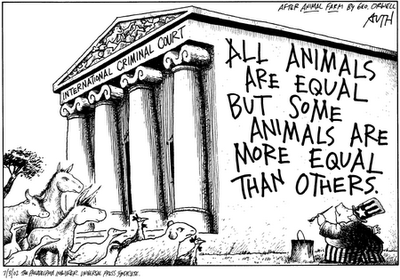
(An interesting take on the current state of our society...)
Level playing field? Maybe not.
Education seeks to level the playing field but like all things- this is not an ideal world. As great as it would be to have it be a totally equal playing field, it is currently a work in progress. Class and thus money determines what kind of education one can afford. A person from Brooklyn will not have the same education as someone who grew up in a rich suburb with private schools galore. It makes things far more equal however, it cannot entirely level the playing field. Some people with still have a little bit of trouble getting across. However, there is sometimes a pattern of those who can afford a top notch education, do not take it, and yet someone who wants an education cannot get one. Ah life!

Crazy Genius or Just Crazy? a google search inspired title
Within the Price forward author Tobin Siebers writes that, "individuals who fail the standards are not only considered unfit for the classroom, they are suspected of being unfit for life."
I found this quote to be in opposition to the ideaology that, "mental illness, namely, its link to creative genius" is a truism upheld in film (the example given being A Beautiful Mind) presented in the Price Introduction.
Culturally, we presently cite figures such as Steve Jobs and Mark Zuckerbrod as examples of individuals who are crazy smart but didn't fit into the mold of college/university life. They left either because of burgeoning business ventures or social alienation (here I am extrapolating from The Network). These men, and surely there are female equi
It seems to me that the NORMAL thing (since I feel this will be a recurrent theme throughout class) is actually to have some sort of disability or impairment the notion of closeting here can be intereting to me. Often when one has unknown are invisible disabilities they are closeted or pusposefully hidden

Remote Ready Biology Learning Activities

Remote Ready Biology Learning Activities has 50 remote-ready activities, which work for either your classroom or remote teaching.
What's New? Subscribe to Serendip Studio
A Random Walk
New Topics
-
1 week 1 day ago
-
1 week 1 day ago
-
1 week 1 day ago
-
1 week 1 day ago
-
1 week 4 days ago
