
Serendip is an independent site partnering with faculty at multiple colleges and universities around the world. Happy exploring!

Kai's Poem
The poem/video we watched by Kai Davis brought up many good points on racial views. She spoke very negative of how school is structured and why its structured that way. Her views of how black people are viewed brought up history's view on blacks. What she said that struck me the most was "does having a 4.0 mean I'm 4 shades lighter?" People viewed her as "white" because of her grades. The way she worded it was the part that really got to me, how people sterotype others, or how people sterotype themselves. I mainly liked the poem because she didn't sensor anything she was saying and thats how things should be.
Education and the (Financial) "Playing Field"
Being a student who is using education to climb out of the lower class, the idea of "leveling the playing field" is one that I think of often. I consider myself privileged in this respect: though my mother is disabled and has raised me on her own along with two other (foster) children, she has always emphasised the importance of educational motivation and has been willing to sacrifice to make this possible for us.
Not everyone is as fortunate. Many cannot even fathom the idea of becoming educated beyond high school: some must halt their educational careers even before high school graduation to care for their families, while others have become so disillusioned with or otherwise discouraged by the educational system that it seems as if it is not worth it. Of course, the public school system doesn't do much to help: as Shannon has stated, I have experience with people who have been "pushed through" public school despite performing poorly in class, putting them at a further disadvantage in standardised tests and increasing the possibility of dropping out of college.
Education levels the playing field
The playing field in America is definitely not level, but I believe that education is not at fault. Education is something everyone should acquire because it allows people to further themselves in life. For instance, in Shorris' study where he gave lower class a basic education, it allowed them to continue on to college and hold their own. However, even though many people are becoming education, those who "make it" or find the level where they can compete with others in life, have certain characteristics that allow them to reach this place, and its not their level of education. It is money and connections. Shorris' students, although they did not have money, found the connections through his program that allowed them to continue onto college and make a name for themselves. Other students have money. The ability to pay for college automatically puts that person ahead of one who cannot afford an education. And even on a smaller scale with kids in the same school district, some parents may be able to afford to send them on community service trips or pay for music lessons. The ability to pay for these things is basically the ability to buy yourself into college, because it is these things, the extra circulars, that make a difference in the college application. Basically, the playing field really can't be leveled when personal finances come into play.

Reflection of in class video
The video we watched in class was interesting for me because at my school no one was criticized for being smart. We had a huge amount of diversity with kids from all over the world. Also, I believe it is because it was private schools were everyone was from the same socioeconomic class. Because of this, no one race was seen as less intelligent than the other. Therefore, this video, for me, for me brought to light the fact that no every school is as fortunate. Overall, I thought the video was an excellent way for this young woman to get her point across. I thought it was clever how she mixed very vulgar words with highly eloquent speech; it defiantly helped her to get her point across. Even though I thought it was clever however, one of my classmates stated that “it was just another black person complaining about the situation”, and since I am not black and I have not experienced this within my school, I feel that my opinion is insignificant.

Alert! Syllabus change.....
Jody and I have been fiddling with the syllabus this weekend.
For Tuesday, please read the essay by Pedro Noguera. We will not have time to talk through the Massey and Denton study of residential segregation, so have moved that into the category of optional/additional reading (in other words, you can let that one go...)
Please do bring bell hooks back to class with you, though; we are not done w/ her yet (and we suspect she is not quite done with us, either!).
When you post on Serendip tonight, please answer our general question about whether education levels the playing field by focusing on a specific dimension of the problem. You might want to talk about your reactions to the spoken word video of kai davis, for example; or the claim by bell hooks that decorum and censoring undermine the democratic exchange of ideas in the classroom; or her assertion that the academic work process is essentially antagonistic to the working class, or....??
Looking forward to our further conversation, both on-line and in-person--
Anne (for me and Jody)

The Closet as a Means of Self Perservation
I have been thinking about the problem of external categorization since our second class meeting, when we discussed “Living The Good Lie”. I have been chewing on the idea that academia has a habit of categorizing behaviors, world views, and modes of operation from the outside, as though we are somehow rightful arbiters of others’ behavior. I think this is a natural thing for us to do, especially since we are doing it within the context of a class which seeks to explore the issues of categorization and false binaries. However, I wonder if we are not so entrenched in our ideas of what is “right” that we are unconsciously mapping our preferred MO’s onto others.
For instance, when we discussed the men in the Times article who were seeking to remain deeply closeted in order to not break away from their religious communities, we all seemed to react the same way, at least initially. Many of us wondered why these men, who were born gay, would not just choose to find a new church.

Some rambling and a question for the class
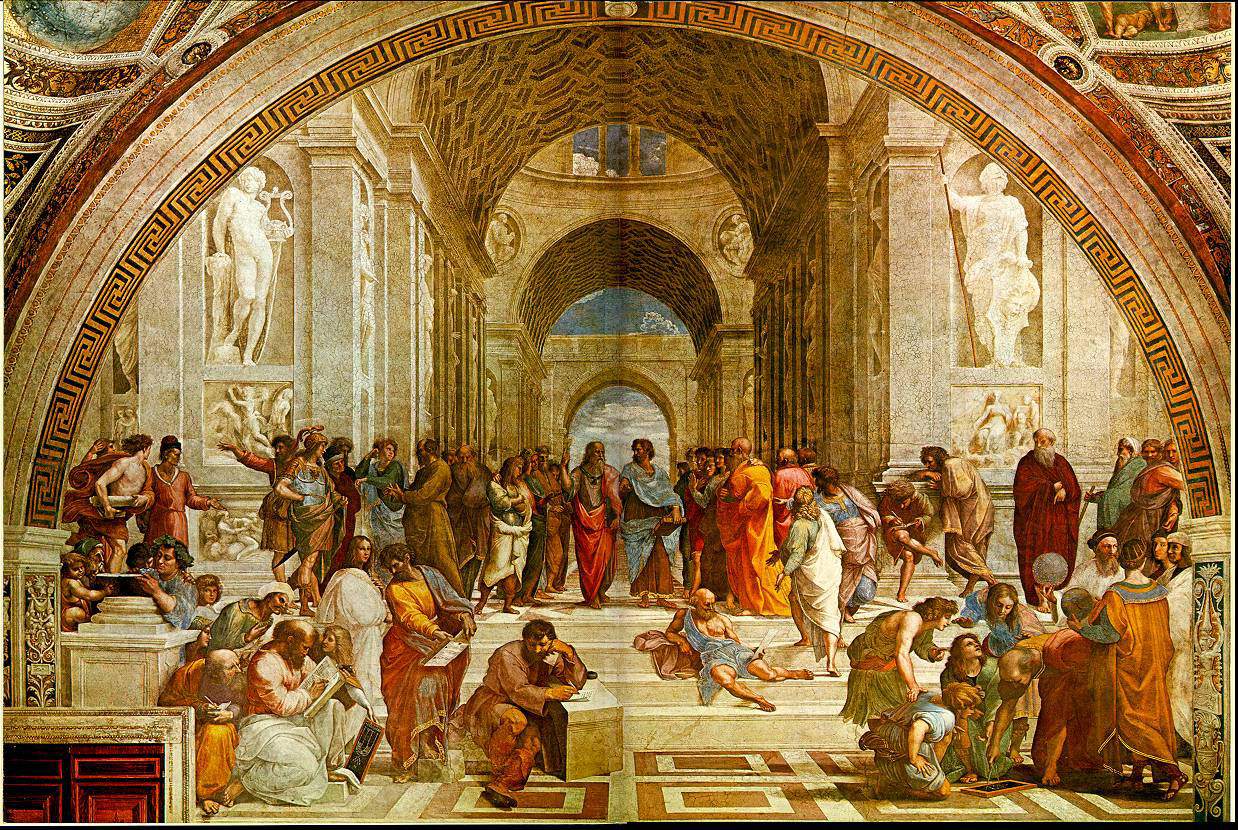
In Price’s introduction she mentions the sanctity of knowledge, the ivory tower of thought only open to the privileged genius of our era, the perfect academic who can meet with other academics in their spheres of thought, to sit and talk at length about theories of the universe or the meaning of life. When I read this I immediately thought of Renaissance paintings such as Raphael’s School of Athens. That ideal of academia, Plato and Aristotle debating at length under the majestic stone archways, walking the tiled halls with fellow thinkers pushes out, as Price said, the teacher who can’t sit in a staff meeting or the child who can’t control their outbursts in class. We are constantly barraged by images of the perfect; models whose size and proportions have been digitally altered for magazine covers, students who score perfect SAT or ACT scores and not only are admitted to every Ivy League school but receive a full ride on a sports scholarship. Rare are the John Nashes and the Marlee Matlins who occupy the spotlight in our world today.

Remote Ready Biology Learning Activities

Remote Ready Biology Learning Activities has 50 remote-ready activities, which work for either your classroom or remote teaching.
What's New? Subscribe to Serendip Studio
A Random Walk
New Topics
-
1 week 1 day ago
-
1 week 1 day ago
-
1 week 1 day ago
-
1 week 1 day ago
-
1 week 4 days ago
