Serendip is an independent site partnering with faculty at multiple colleges and universities around the world. Happy exploring!

Fun Facts About Neurons

Here are some interesting statistics* about neurons in humans and other animals (remember that these are averages because there is a lot of variability in the nervous system!):

  • Average number of neurons in the human brain = 100 billion
  • Average number of neurons in the octopus brain = 300 million
  • Rate of neuron growth during fetal development in utero = 250,000 neurons/minute
  • Diameter of a neuron = 4 to 100 microns
  • Length of giraffe primary afferent axon (from neck to toe) = 15 feet
  • Velocity of signal transmitted through a neuron = 1.2 to 250 miles/hour
  • There are as many neurons in the human brain as stars in the Milky Way
  • The number of ways information travels in the human brain is greater than the number of stars in the universe

What if we lined up all the neurons in our body? How long would that line stretch?

Let's assume that one neuron is about 10 microns long. Remember, this is just an example, because neurons come in all different sizes. So, if we line up 100 billion neurons which are 10 microns long...


100,000,000,000 neurons x 10 microns = 1,000 km or about 600 miles!


This may help with the math:
1,000 microns= 1millimeter (mm)
10 mm = 1 centimeter (cm)
100 cm = 1 meter (m)
1,000 m = 1 kilometer (km)

 

Nerve Cells

The Amazing Neuron


Animated Neuron


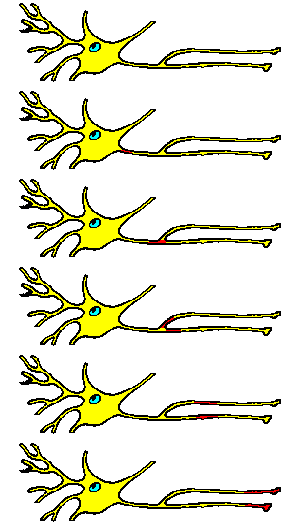
Neurons come in a variety of shapes and sizes, depending upon their function and specialized structures. However, in general, all neurons work in the same manner and resemble each other. And, in addition, our neurons look almost exactly like the neurons of a dolphin, a cat, or a squirrel!

What do you notice about the image above?

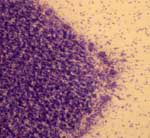
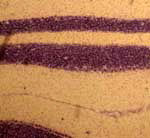
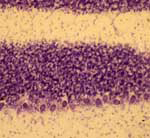
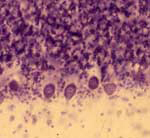
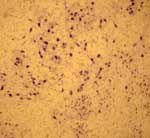
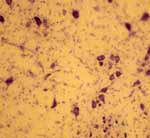
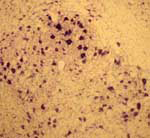
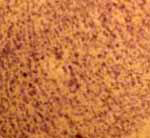
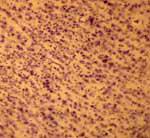
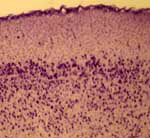
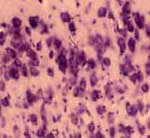
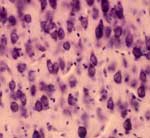
The Cerebellum Magnified

  MAGNIFIED 4x MAGNIFIED 10x MAGNIFIED 20x
HUMAN 4x Photomicrograph Human Cerebellum 10x Photomicrograph Human Cerebellum N/A
MONKEY 4x Photomicrograph Monkey Cerebellum 10x Photomicrograph Monkey Cerebellum 20x Photomicrograph Monkey Cerebellum
CAT

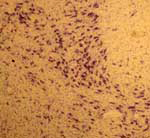
The Hindbrain Magnified

  MAGNIFIED 4x MAGNIFIED 10x MAGNIFIED 20x
HUMAN 4x Photomicrograph Human Hindbrain 10x Photomicrograph Human Hindbrain  N/A
MONKEY 4x Photomicrograph Monkey Hindbrain  10x Photomicrograph Monkey Hindbrain  N/A
CAT 4x Photomicrograph Cat Hindbrain

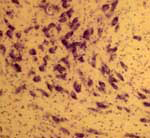
The Forebrain Magnified

  MAGNIFIED 4x MAGNIFIED 10x MAGNIFIED 20x
MONKEY 4x Photomicrograph Monkey Forebrain  10x Photomicrograph Monkey Forebrain  N/A
CAT 4x Photomicrograph Cat Forebrain 10x Photomicrograph Cat Forebrain  20x Photomicrograph Cat Forebrain 

drafting a slide show for serendip

playground

Rachel Grobstein, "I Don't Know Where I'm Going, Yeah! (Pinball Painting with the Bone of Tycho Brache)

brain and behavior

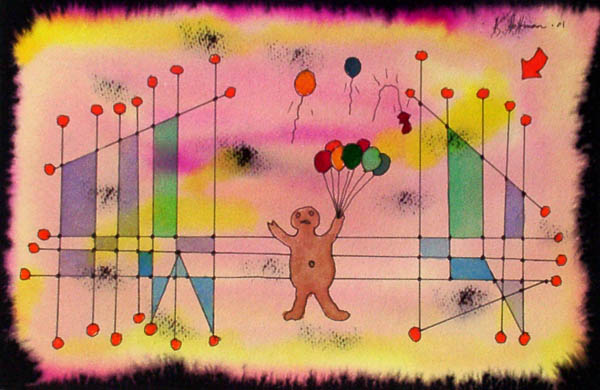
Howard Hoffman, "Everyone Seems Normal..."


complexity and emergence

Workbooked: The Role of Smoking Cigarettes in the Education of a Young Jew, Jody Cohen

Prompts for Further Writing and Thinking, Alice Lesnick


Writing to Read
As you re-read Cohen’s poem, make two lists – one of elements (things, ideas, experiences, terms) in it that break or are broken, and one of elements in it that don’t break, that continue. Don’t try too hard to get it right – just see where the lists go.

Do some process writing about what you notice about each list and how the two are alike and different.

Choose one element from each list. Write a focused freewriting in which you discuss how these two elements help make Cohen’s poem about learning. How do people learn, according to this poem? What is an education?

Prompts for Collaborative Learning
What does a game of Solitaire have to do with the education of a young Jew?
How do people breathe in this poem?
Who is the “we” in the last stanza?

Process Writing

Workbooked: Breaking: A Life Story in 10 Fragments, Anne Dalke

Prompts for Further Writing and Thinking, Alice Lesnick

Writing to Read

Think on paper using each of the following questions to prompt a focus freewriting.  Remember, these take about 7 minutes, and the only rule is that you keep writing the entire time, even if you aren’t sure where you are going.  As J.R.R.

The Breaking Project: People/Community

(photo: Anne Dalke)


Learn a little more about the people who are a part of The Breaking Project's community.

As Ursula Le Guin says in The Dispossessed, we are "Members of a community, not elements of a collectivity" and "there [are] as many emotions [here] as there [are] people." If you are interested in submitting a piece to the project, please visit this page for more information.

Community

Alice Lesnick -- As a teacher and writer, I am interested in collaboration and change.  I serve as director of the Bryn Mawr/Haverford Education Program at Bryn Mawr College.  I am exploring what it means to begin with the idea that, in Bharath Vallabha's terms, "every individual is at the cutting edge of the universe."

Elizabeth Catanese is a visual artist, poet and teacher who is working to live honestly and authentically and connect with the creative energy of others.

Alice Lesnick's Resources

INSTITUTE FOR WRITING AND THINKING, BARD COLLEGE

In designing many of the prompts I wrote, I (Alice Lesnick) have drawn on the philosophy and practices of the Institute for Writing and Thinking at Bard College. Our approach refuses easy divisions between personal and public meanings, academic and experiential knowledg.  At base, the Institute’s approach to writing to learn is based on the premise articulated by Paul Connolly (the Institute’s Director between 1982 and 1998) that to think is to make language choices. Learning to think is nourished by ongoing opportunities to write informally and in community.  Inquiry is playful.  Writing is revising.

 Thus, the prompts I have crafted to follow each text are deliberately odd-angled, disarming, and playful.  They are supposed to be surprising and to yield surprising ways forward.

The prompts following each selection are presented in six categories: Writing to Read; Prompts for Collaborative Learning; Process Writing; Writing Back; Writing More; and Breaking Media. The purposes of each of this are as follows:

Syndicate content