Serendip is an independent site partnering with faculty at multiple colleges and universities around the world. Happy exploring!

activities for teaching biology

Learning about Genetic Disorders

This activity provides brief instructions and recommended reliable sources for students to investigate and report on a genetic disorder of their choice. The Student Handout is available in the first two attached files and as a Google doc designed for use in online instruction and distance learning.The Teacher Notes, available in the last two attached files, provide instructional suggestions and background information.

Soap Opera Genetics – Genetics to Resolve Real-Life Dilemmas

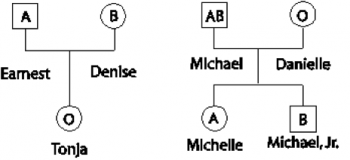
Family tree by blood type

This analysis and discussion activity contains three "soap opera" episodes that help students to understand the principles of inheritance and the relevance of genetics to everyday life. In the first episode, students answer the probing questions of a skeptical father who wants to know how his baby could have albinism when neither he nor his wife have albinism.

The second episode, "Were the babies switched?", covers the concepts of codominance, incomplete dominance, and polygenic inheritance, and reinforces student understanding that the alleles of a gene give the instructions for making different versions of a protein.

In the third episode, students analyze sex-linked inheritance. Each episode can be used separately or with other episodes, depending on your teaching goals.

The Student Handout is available in the first two attached files. The Teacher Notes, available in the last two attached files, provide instructional suggestions and background information and explain how this activity is aligned with the Next Generation Science Standards.


Genetics – Major Concepts, Common Misconceptions, and Learning Activities

Part I summarizes key concepts in genetics. Part II presents common misconceptions. Part III recommends an integrated sequence of learning activities on the biological basis of genetics, plus seven human genetics learning activities. These learning activities develop student understanding of key concepts and counteract common misconceptions. Each of these recommended learning activities supports the Next Generation Science Standards (NGSS).

Mitosis, Meiosis and Fertilization Vocabulary Review Taboo Game

This game helps students to enjoy reviewing vocabulary related to mitosis, meiosis and fertilization.  Each card in the deck has a target vocabulary word and two related taboo words that the student may not use as he/she gives clues so the other students in his/her small group can guess the target word.  Many students have trouble learning the substantial new vocabulary required for biology, and this game lets students have fun while reinforcing their understanding of key terms. 

The first file below provides the master copy for creating the card decks for this game, and the second file below provides the teacher notes, including instructions for playing the game.


Mitosis and Meiosis Card Sort

Mitosis and Meiosis Card Sort Activity

This activity is designed to help students review the processes of mitosis and meiosis and to ensure that students understand how chromosomes move during mitosis vs. meiosis. Students arrange the cards from a shuffled deck of the stages of mitosis and meiosis in the sequence of steps that occur during cell division by mitosis and another sequence of steps that occur during cell division by meiosis.  The first file shown below can be used to print the simpler version of the deck of cards for this activity and the second file can be used to print the more challenging version of the deck of cards for this activity. The third file gives the teacher notes.


Enzymes Help Us Digest Food

In this hands-on, minds-on activity, students investigate the biological causes of Maria’s symptoms and Jayden’s symptoms. To explore the causes of these symptoms, students carry out two experiments and interpret the results, and they answer additional analysis and discussion questions.

Students learn about enzyme function and enzyme specificity as they figure out that Maria’s symptoms are due to lactase deficiency (resulting in lactose intolerance) and Jayden’s symptoms are due to sucrase deficiency.

In the final section, students are challenged to generalize their understanding of enzymes to interpret a video of an experiment with saliva, starch and iodine. This activity can be used in an introductory unit on biological molecules or later during a discussion of enzymes.

Download Student Handout: PDF format or Word format

Download Teacher Preparation Notes: PDF format or Word format

Cellular Respiration and Photosynthesis – Important Concepts, Common Misconceptions, and Learning Activities

These Teacher Notes summarize basic concepts and information related to energy, ATP, cellular respiration, and photosynthesis. These Teacher Notes also review common misconceptions and suggest a sequence of learning activities designed to develop student understanding of important concepts and overcome any misconceptions.

The attached files describe the key concepts, common misconceptions and suggested learning activities (in Word and PDF formats).

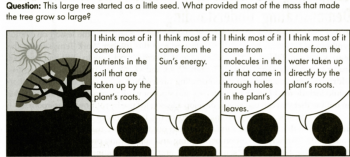
Where does a tree's mass come from?

4 hypotheses where plant's mass comes from

Students analyze evidence to evaluate four hypotheses about where a tree’s mass comes from. 

Students engage in scientific practices as they learn that trees consist mainly of water and organic molecules and most of the mass of the organic molecules consists of carbon and oxygen atoms that came from carbon dioxide molecules in the air.

For example, students analyze Helmont’s classic experiment and evaluate whether his interpretation was supported by his evidence.

The Student Handout is available in the first two attached files. The Teacher Notes, available in the last two attached files, provide instructional suggestions and background information and explain how this activity is aligned with the Next Generation Science Standards.

Plant Growth Puzzle – Photosynthesis, Biosynthesis and Cellular Respiration

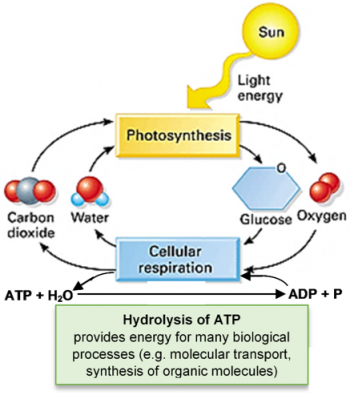
Photosynthesis and cellular respiration cycle with the hydrolysis of ATP

This minds-on analysis and discussion activity challenges students to explain changes in biomass for plants growing in the light vs. dark. Students analyze how photosynthesis, biosynthesis, and cellular respiration affect biomass.

The Teacher Notes suggest three possible additions to this activity that expand student understanding of photosynthesis, cellular respiration, hydrolysis of ATP, biosynthesis, and starch. (NGSS)

The Student Handout is available in the first two attached files and as a Google doc designed for use in distance learning and online instruction. (For additional instructions, see https://serendipstudio.org/exchange/bioactivities/Googledocs, especially item 7.) The Teacher Notes, available in the last two attached files, provide instructional suggestions and background information and explain how this activity is aligned with the Next Generation Science Standards.

Syndicate content