Serendip is an independent site partnering with faculty at multiple colleges and universities around the world. Happy exploring!

activities for teaching biology

Genetics and Probability – Sex Ratios of Births

In this minds-on analysis and discussion activity, students analyze the inheritance of sex chromosomes. Students use a Punnett square to predict the sex ratio of births and compare their prediction to data for individual families and for the entire US.

As students analyze the reasons why many real families deviate from Punnett square predictions, they learn about the probabilistic nature of inheritance and the limitations of Punnett square predictions.

A mistake in copying DNA can result in dwarfism.

In this minds-on activity, students analyze evidence about achondroplasia to learn how a mistake in DNA replication can result in a new mutation that affects a child’s characteristics.

This analysis and discussion activity reviews several basic genetics principles and helps to counteract several common misconceptions about genetics.

Introduction to Genetics – Similarities and Differences between Family Members

In this analysis and discussion activity, students learn that different versions of a gene give the instructions for making different versions of a protein which can result in different characteristics.

Additional questions guide students as they review how genes are transmitted from parents to offspring by the processes of meiosis and fertilization.

Then, students analyze several examples that illustrate how inheritance of genes can result in similarities and differences between family members.

Concepts covered include Punnett squares, dominant and recessive alleles, incomplete dominance, and polygenic inheritance. These concepts are reinforced in an optional final review page.

Understanding How Genes are Inherited via Meiosis and Fertilization

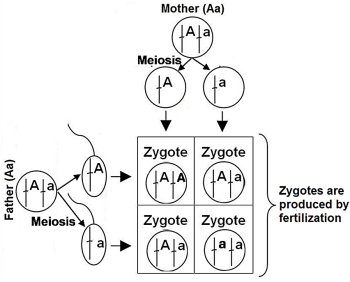
In this minds-on analysis and discussion activity, students learn how a child inherits one copy of each gene from each parent through the processes of meiosis and fertilization.

Then, students follow the alleles of a human gene from the parents' diploid cells through haploid gametes and diploid zygote to a child’s diploid cells.

They learn how the possible outcomes of meiosis and fertilization are summarized in a Punnett square.

We recommend that this activity be followed by "Meiosis and Fertilization Produce Genetic Diversity"(https://serendipstudio.org/exchange/bioactivities/gendiversity).

A hands-on version of this activity and the recommended subsequent activity is available as “Meiosis and Fertilization – Understanding How Genes Are Inherited”.

Mitosis and the Cell Cycle – How the Trillions of Cells in a Human Body Developed from a Single Cell

In this minds-on analysis and discussion activity, students learn how the cell cycle produces genetically identical daughter cells. They analyze how DNA replication and mitosis work together to ensure that each new cell gets a complete set of chromosomes with a complete set of genes.

To understand how a single cell (the fertilized egg) can develop into the trillions of cells in a human body, students analyze an exponential growth model for the increase in number of cells. The final section provides a brief introduction to cellular differentiation.

This activity can be used as an introduction to mitosis or to reinforce understanding of mitosis. A hands-on version of this activity is available as “Mitosis and the Cell Cycle – How a Single Cell Develops into the Trillions of Cells in a Human Body”.

Food Webs – How did the elimination and return of wolves affect other populations in Yellowstone?

To begin this hands-on, minds-on activity, students view a video about ecosystem changes that resulted when wolves were eliminated from Yellowstone National Park and later returned to Yellowstone. Then, students learn about food chains and food webs, and they construct and analyze a food web for Yellowstone. Finally, students use what they have learned to understand a trophic cascade caused by the elimination of wolves from Yellowstone.

This learning activity provides an introduction to the learning activities, Carbon Cycles and Energy Flow through Ecosystems and the Biosphere and Trophic Pyramids. All three of these activities are included in Food Webs, Energy Flow, Carbon Cycle and Trophic Pyramids, which is intended for classroom instruction.

Carbon Cycles and Energy Flow through Ecosystems and the Biosphere

In this analysis and discussion activity, students learn that the biosphere requires a continuous inflow of energy, but does not need an inflow of carbon atoms.

To understand why, students apply fundamental principles of physics to photosynthesis, biosynthesis, and cellular respiration, the processes which are responsible for carbon cycles and energy flow through ecosystems.

Thus, students learn how ecological phenomena result from processes at the molecular, cellular and organismal levels.

Trophic Pyramids

In this analysis and discussion activity, students discover the reasons why (in many ecosystems) plants are more common than primary consumers, which in turn are more common than secondary consumers.

To begin, they learn about the factors that influence the net rate of biomass production. They figure out why the net rate of biomass production is lower for each higher trophic level in an ecosystem.

Then, students construct and analyze trophic pyramids. Finally, they apply what they have learned to understanding why more resources are needed to produce meat than to produce an equivalent amount of plant food.

Coronavirus Evolution and the Covid-19 Pandemic

In this analysis and discussion activity, students learn that the coronavirus responsible for the current pandemic very probably originated in bats. Students analyze how mutations and natural selection can produce a spillover infection.

Next, students learn how natural selection increased the frequency of a mutation that made the coronavirus more contagious.

Finally, students analyze how mutations contributed to the spread of the Omicron variant and its subvariants.

Coronaviruses – What They Are and How They Can Make You Sick

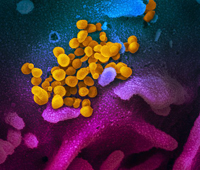
Cross section of Coronavirus

In the shorter version of the Student Handout, students learn how coronaviruses are replicated inside our cells, how white blood cells fight a coronavirus infection, and how a coronavirus infection can cause you to feel sick.

In the longer version of the Student Handout, students also learn how the respiratory and circulatory systems work together to provide oxygen to the body’s cells, and they learn how a coronavirus infection can interfere with oxygen delivery, which can result in severe disease.

Syndicate content